
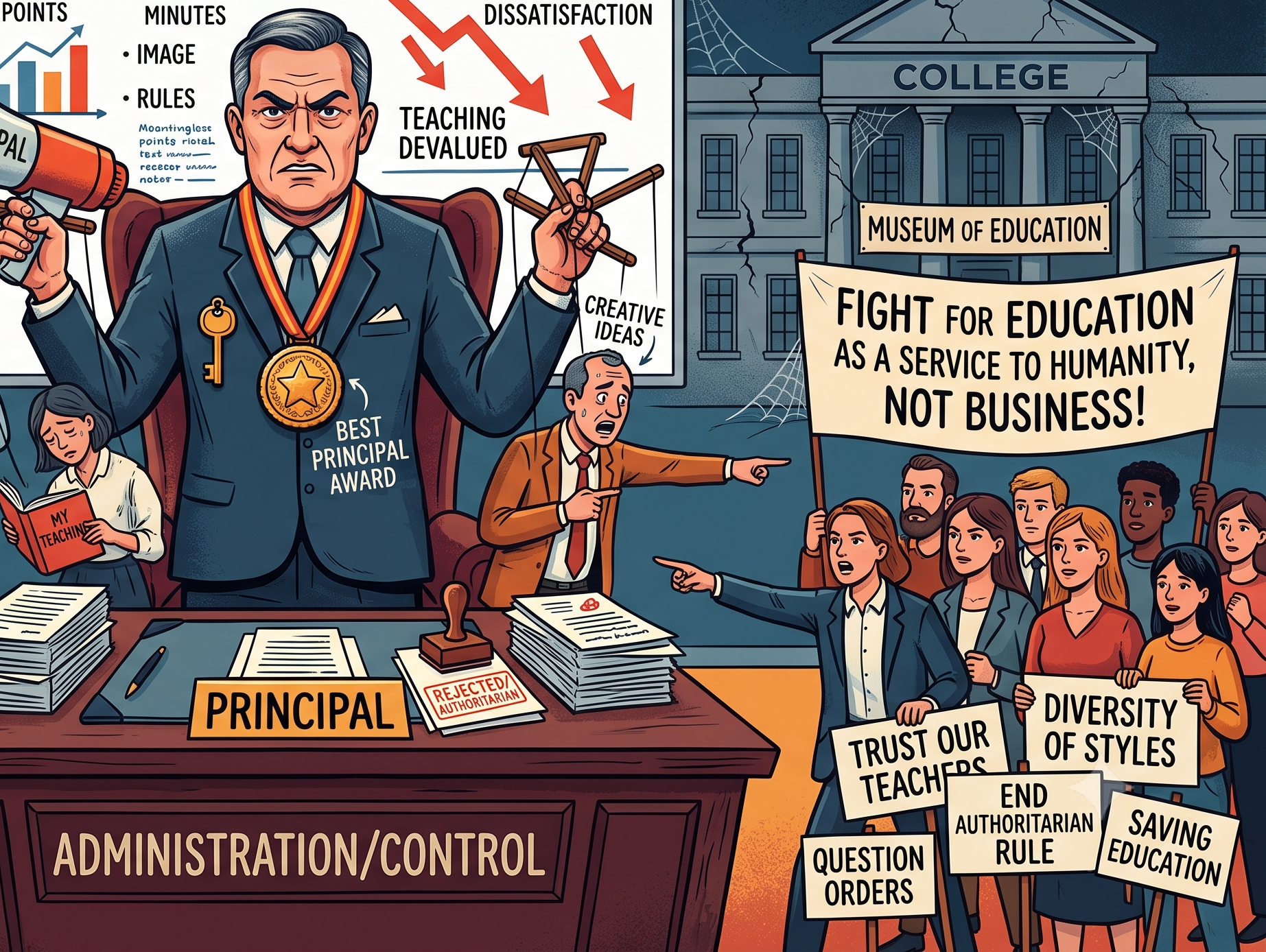
Unfortunately, in today’s colleges, some principals often act more like bosses than leaders. They are not leaders in the truest sense of the word. Instead of trusting their colleagues, they tend to micromanage everything. They try to boss people around and control them rather than encourage their staff to perform at their best.
They often measure committee work as “work” while disregarding teaching, perhaps because it helps them project an image of being the “best principal” by accumulating the most accreditation points. If this is the state of affairs, then we have a serious problem. Education will suffer because every teacher should not be forced to follow the style of someone who simply happens to occupy a particular position.
Imagine having to tailor your teaching methods and evaluation practices to something unreasonable simply because the principal tells you to do so. That principal may have no understanding of your subject and may not possess the necessary subject knowledge. Yet, they still try to prevent you from doing what is genuinely good for the institution, perhaps because you do not blindly follow orders and instead choose to be rational and honest.
Unfortunately, such leaders often seem to prefer people who simply agree with them. Perhaps this stems from insecurity or a lack of confidence in their own administrative abilities. Instead of nurturing young professors and encouraging them to become dynamic educators, they drive them away from the profession through authoritarian behaviour and unnecessary restrictions. Worse still, they may appoint incompetent heads of departments, allowing things to go wrong while leaving themselves with convenient scapegoats to blame.
They may even be willing to sacrifice the institution in order to protect their own image. It is unfortunate that such people exist, but we must continue to fight to ensure that education remains a service to humanity rather than becoming merely a business.
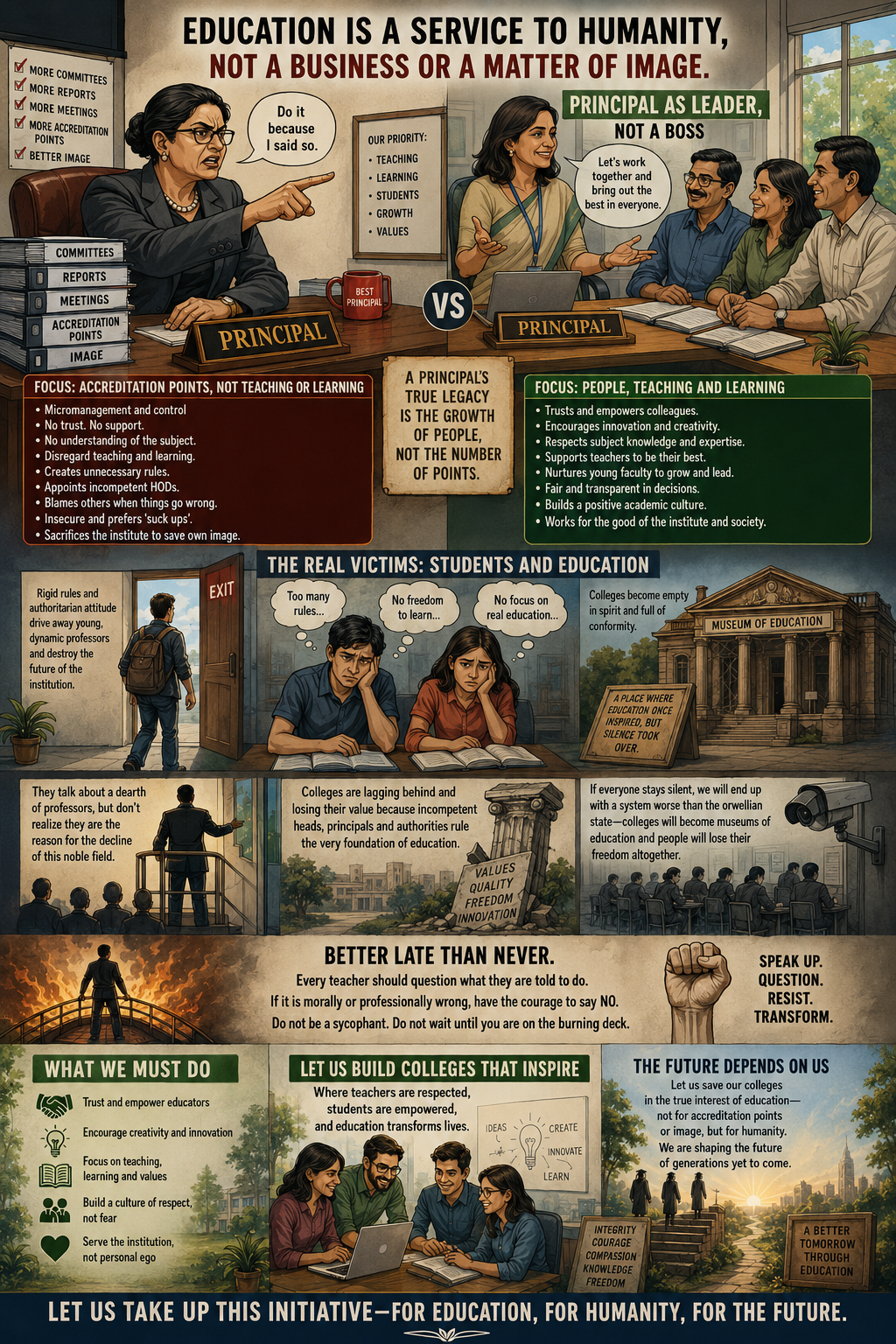
These very same principals often give speeches about the shortage of professors, without realising that their own rigid rules and authoritarian practices are contributing to the decline of this noble profession. They introduce more and more unnecessary rules, making life miserable for teachers and students alike, often without considering whether those rules actually improve education.
This is one of the reasons why colleges are falling behind and losing their value. When incompetent heads, principals and authorities are allowed to control the very foundations of an educational institution, the institution itself suffers. Only when such practices are challenged and rooted out can education truly change for the better.
Better late than never, every teacher should question what they are being told to do. If something is morally or professionally wrong, they should have the courage to refuse to do it. One should not simply sit quietly and become a sycophant, only to eventually find oneself standing like the proverbial person on a burning deck.
The future depends on people who are willing to step outside their comfort zones and do more. Sadly, if everyone remains silent, we could end up with a system that resembles an Orwellian state, where conformity matters more than truth and independent thought.
If everyone continues to remain silent, colleges may eventually become museums of education—institutions that preserve the appearance of learning while losing the very spirit that makes education meaningful. Eventually, people may lose their freedom to teach, question and innovate altogether.
Let us take up the initiative to save our colleges in the true interest of education—not merely in the interest of earning accreditation points or projecting an impressive image. We are not just deciding the future of our institutions; we are shaping the future of generations yet to come.
Disclaimer: For those fuddy-duddies who may misconstrue my views, this article does not reflect any particular institute, school, college, university or country.