Author: Aaron Johns

  • The Vanishing Teacher

    The Vanishing Teacher

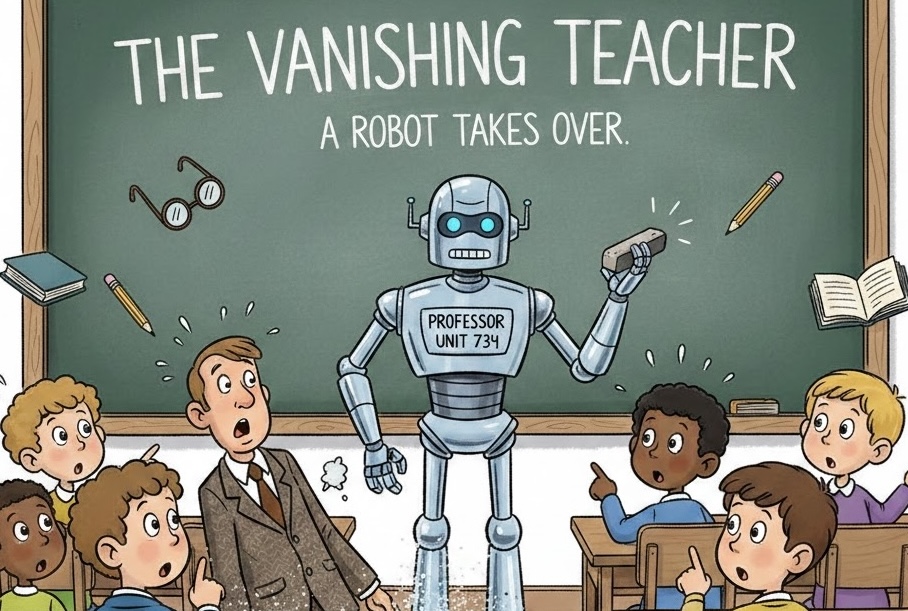
    Education today is more about teachers following orders like obedient robots than about encouraging rational thinking. Teachers have become more commercially oriented and are no longer concerned with truly teaching and nurturing students. Instead, they focus on filling out forms and publishing lavish research papers that lack substance. In class, they merely read from slides or PDFs like narrators, instead of teaching students the practical know-how required to sharpen their skills. They distribute question banks and expect students to learn solely from them.

    This approach leads students to stop using their reasoning abilities and become addicted to the “candy” of rote learning. They often resent authentic teachers who genuinely teach because such teaching requires them to think. If a generation cannot think, someone else will think for them—and that leads to manipulation and control by AI and others.

    Today’s department heads, principals, and management seem concerned only with earning points and maintaining a false image of an educational institution. They appear less concerned about student welfare and more focused on money, reputation, and profit. Institutions are beginning to function more like corporate entities than places dedicated to learning. It has evolved into a business-oriented activity rather than a social service.
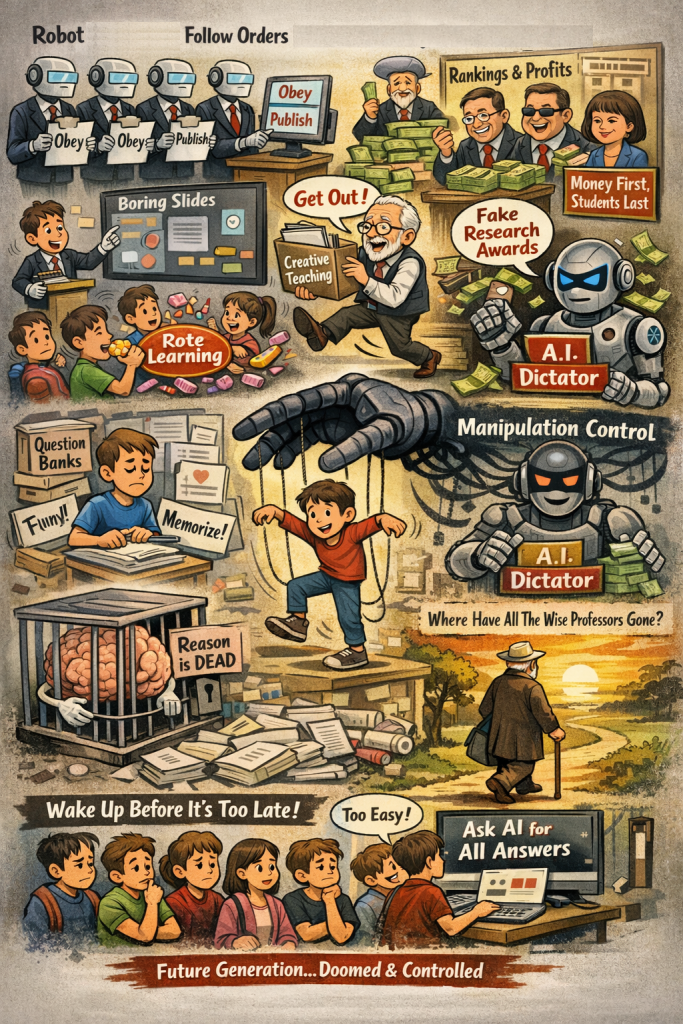
    The education space has also become a political minefield of favoritism. A teacher who genuinely teaches well and nurtures students is sometimes treated as a nuisance because rational thinkers are not preferred over professors who simply follow orders—even if they teach poorly and publish research papers with no real-world impact. In many cases, good teachers are shown the door while ineffective ones remain. If this is the state of education, we are doomed for all of the future generations.

    Where have all the good old professors gone—those who encouraged students to think outside the box and be creative? It seems that true educators are disappearing, while those motivated primarily by monetary benefits are entering the profession. Today, we need genuinely skilled PhDs and dedicated educators who can contribute meaningfully to the nation’s growth—not merely namesake PhDs.

    Unfortunately, in today’s classrooms, AI is not being used effectively. Instead of enhancing critical thinking, it often encourages students to drift away from real-world reasoning. They begin to live in an idealistic bubble, which can ultimately lead to self-inflicted setbacks. Many students would rather pay to borrow intelligence from AI than think for themselves for free.

    If people do not open their eyes soon, the next generation may become intellectually passive and easily controlled. It is time to wake up and act.

    Disclaimer: For those fuddy-duddies who may misconstrue my views, this article does not reflect any particular institute, school, college, university or country.
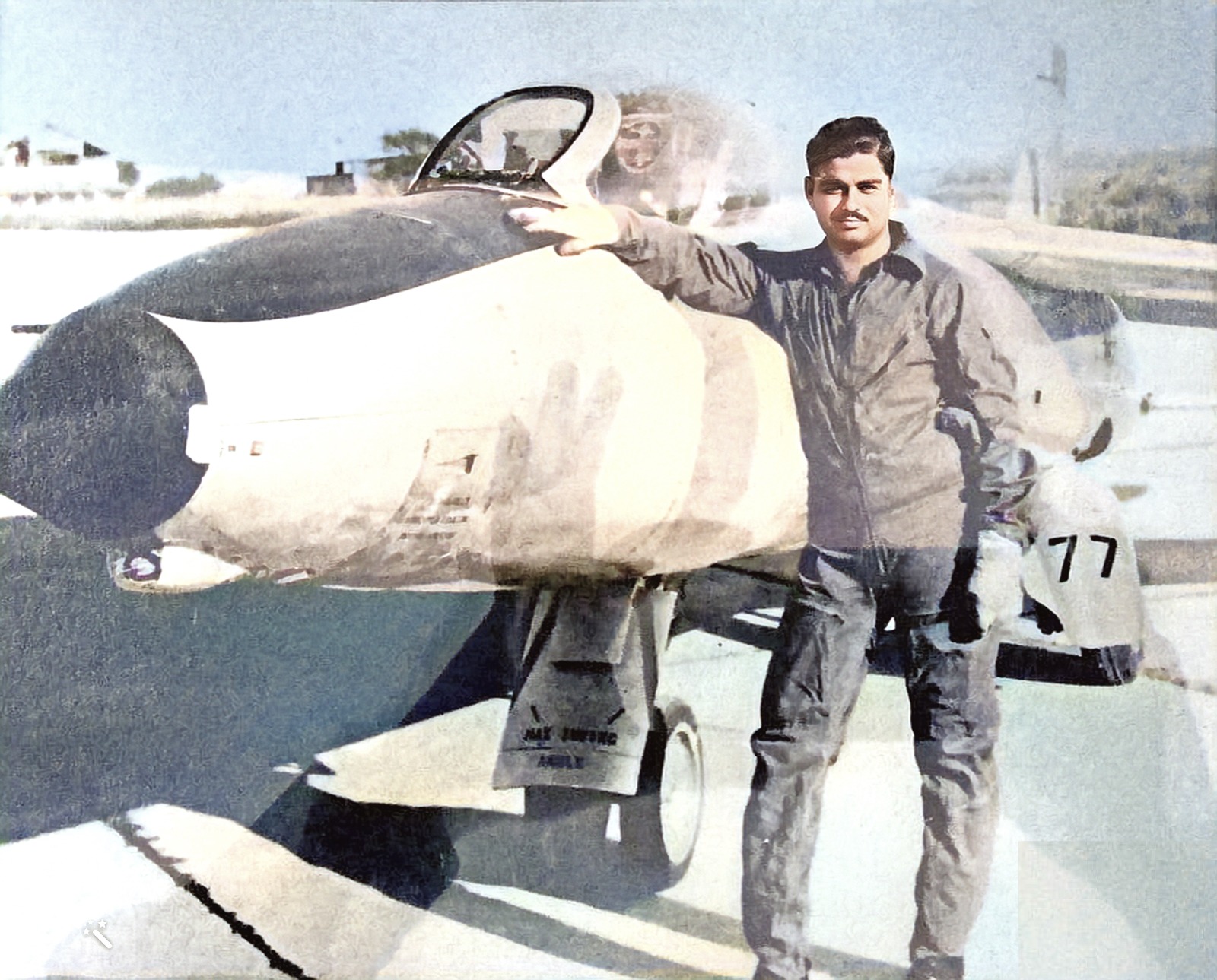
  • A Tribute to Group Captain Trevor Joseph Fernandez (IAF)

    A Tribute to Group Captain Trevor Joseph Fernandez (IAF)

    A Life of Service, Courage, and Legacy

    My late grand uncle, Trevor Joseph Fernandez, was a Group Captain in the Indian Air Force. Fondly known by his nickname “Bull” in the Indian Air Force, he was born to Edward and Ella Fernandez. He followed in the footsteps of both his elder brothers—Stanislaus Fernandez (my grandfather), who served in the Indian Navy as a Commander, and Herman Fernandez, who also served in the Indian Army as a Colonel.

    Trevor Fernandes was involved in Operation Vijay (1961), the military operation undertaken to liberate Goa from Portuguese colonial rule. At the time, he was a young Flight Lieutenant stationed at an airbase in Punjab and was instructed to proceed to Pune for the takeover of Goa. As a member of the Flying Hunters of No. 7 Squadron, he was tasked with destroying the powerful transmitter of Radio Goa (Emissora de Goa) at Bambolim. He successfully carried out the mission at 0710 hours, while the programme “Alvorada Musicala,” which had begun at 0700 hours, was still on air.

    He was subsequently instructed to escort bombers targeting the Dabolim runway. During the mission, he noticed the tail of a Super Constellation aircraft protruding from a hangar at Dabolim. He sought permission from Tactical Air HQ to target the tail in order to immobilize the aircraft. This request was declined due to the risk of civilian casualties.
    (That Super Constellation of Transportes Aéreos da Índia Portuguesa, piloted by Lt Col Solano de Almeida of the Portuguese Air Force from Lages Air Force Base in the Azores—on deputation to TAIP—along with a DC-4 Skymaster of TAP, piloted by Capt Reis, daringly took off from the bombed runway after it was secretly repaired overnight by the Portuguese.)

    He thus participated in the liberation by initiating air operations through bombing of the runways. A Goan by origin (from Pilerne/Siolim), he was commissioned into the Indian Air Force in 1956, and his role in the air attacks marked a significant local contribution to India’s Operation Vijay.

    Group Captain Fernandes was associated with the Gnat aircraft from 1962 onwards and was an active fighter pilot during the 1965 Indo-Pak war.

    Vayu Sena Medal
    Sqn LdrTrevor Joseph Fernandes5287 F(P)Award DateAnnounced 26 Jan 1971
    Details :Squadron Leader Trevor Joseph Fernandez has been associated with Gnat aircraft since September 1962. He has over 1,900 hours of accident-free flying experience, including more than 700 hours on the Gnat. During the IndiaPakistan conflict of 1965, he flew a number of operational sorties. He is an experienced Pilot Attack Instructor and has had great success in training pilots of his unit in gunnery. As a result of the excellent training imparted by him the aircrew trained by him secured high places in the Command Gunnery Meets.Throughout, Squadron Leader Trevor Joseph Fernandez displayed professional skill, leadership and devotion to duty,
    Unit : 26 Sqn
    Reference : Gazette of India dated 4th September 1971 – No.53 – Pres/71 dated 26th January 1971
    Bar to Vayu Sena Medal (Gallantry)
    Sqn LdrTrevor Joseph Fernandes5287 F(P)Award DateAnnounced 26 Jan 1972
    Details :During the operations against Pakistan in December, 1971, Squadron Leader Trevor Joseph Fernandez was the Flight Commander of a Fighter Bomber Squadron. He flew fourteen operations missions in support of our ground forces and was responsible for the destruction of one tank, four vehicles and one enemy gun position He successfully attacked the Sulemanki Head Works scoring direct bomb hits which contributed significantly in halting the enemy Armour. In addition, he also successfully bombed Zaffarwal and Norowal Railway yards and attacked the Radar Unit at Walton.Throughout, Squadron Leader Trevor Joseph Fernandez displayed courage, professional skill and devotion to duty.
    Unit : 26 Sqn
    Reference : Gazette of India dated 7th October, 1972 – No.09 – Pres/72 dated 23rd September 1972

    On one occasion, his aircraft was damaged by anti-aircraft fire, yet he daringly flew it back and landed safely. He was later deputed on a pilot training mission to the Iraqi Air Force. He went on to serve as Commanding Officer at the Bhuj airbase, Director of Operations at Southern Air Command, and held several other key assignments.

    An intelligent and capable officer, he was promoted to Group Captain in 1981 and retired in 1992.

    He passed away from this world on the 15th of January 2023. He is survived by his wife Elsie Fernandez, his son Dr. Bruce Fernandez(presently a Major General in the Indian Armed Forces) and his daughter Mrs. Ursula Fernandez.

    We salute such men of courage and bravery.

    Sources:

    https://www.bharat-rakshak.com/indianairforce/database/5287

    https://www.geni.com/people/Trevor-Joseph-Fernandes-Wing-Commander/6000000024238494957

    https://www.facebook.com/groups/goaspeaks1/posts/546910593271441

    https://www.facebook.com/groups/goenchoavaz/posts/25654295750850333

  • Code, Cars, and Creatures: The Animal Kingdom in Technology

    Code, Cars, and Creatures: The Animal Kingdom in Technology

    There is a trend in which software is either named after animals or uses animal mascots. Vehicles have historically been named after animals. For example: the Mercury Cougar, Ford Mustang (horse), Volkswagen Beetle, Dodge Viper, and Chevrolet Impala.

    Programming languages follow this trend as well. Python is a language named after the snake. Go uses the gopher as its mascot. Rust is associated with a crab, and Impala is named after an antelope.

    Linux has a penguin as its mascot. Seagate named its fastest HDD line the Cheetah drive. Docker has a whale as its mascot. Apple historically named its operating systems after animals such as Puma, Tiger, Leopard, Snow Leopard, Lion, and Mountain Lion.

    Currently, open-source operating systems like Ubuntu Linux name their releases after animals. At the time of writing this article, the current release is named after the quokka. openSUSE has a chameleon as its mascot.

    CockroachDB is named after the insect, symbolizing its resilience—much like a cockroach surviving disasters. Gecko is a well-known web engine used by Mozilla.

    In this way, software developers and publishers help educate the public about the beautiful animals that exist in our surroundings.

  • When Learning Loses Its Voice

    When Learning Loses Its Voice

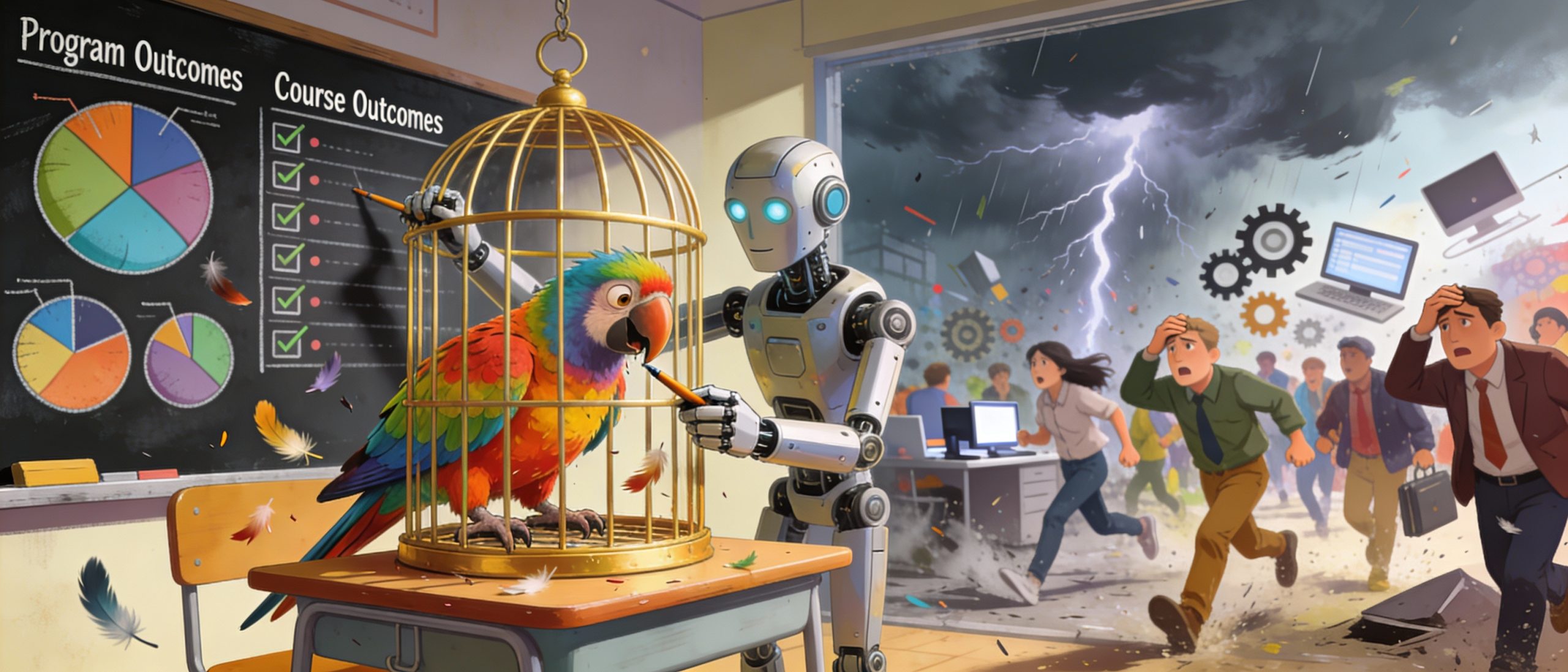
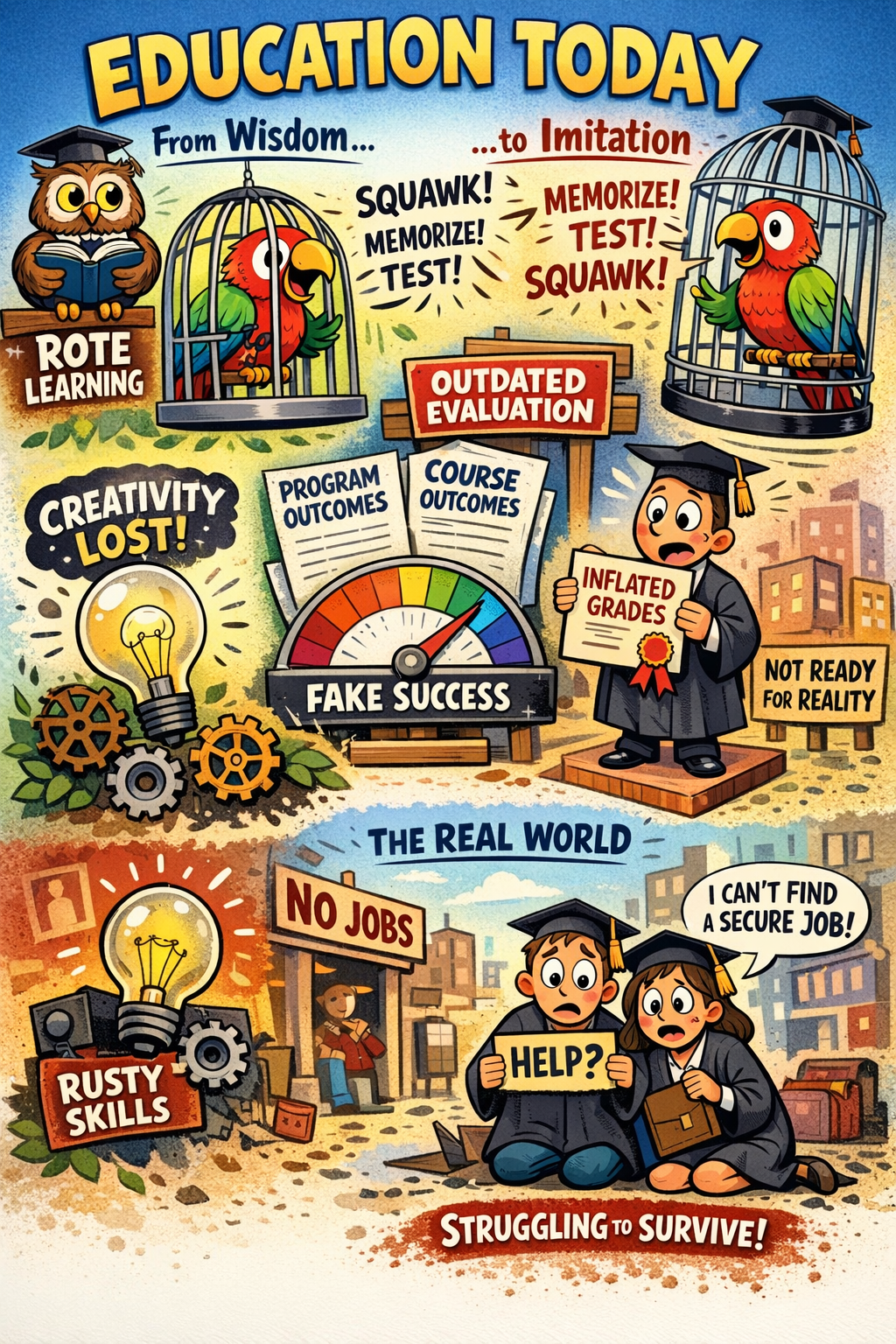
    Education, a word once synonymous with knowledge and wisdom, now feels more like a parrot in a cage, forced to imitate rather than create. Creativity is lost because evaluation methods are outdated. Synthetic benchmarks like program outcomes and course outcomes, implemented in the most ridiculous sense, don’t truly measure a student’s skills. They only produce bloated figures, but when students step into the real world, many struggle to survive and cannot find secure jobs.

    Many students who don’t perform well academically end up doing well in life because they focus on honing practical skills, which eventually shape them into remarkable individuals. The academic space is too rigid, stuck in theory with very little practical application. It blindly follows structured taxonomies instead of embracing flexibility.

    Today, institutes focus more on collecting accreditation points than on the welfare of students and staff. Teaching staff are overwhelmed with administrative tasks, leaving them with insufficient time for meaningful research endeavors. Yet, institutes also push them to publish papers each year to gain points, not realizing that quality research requires time. When rushed, research papers are futile. In the pursuit of accreditation points, education itself is compromised. We shouldn’t chase points; the points should come to us if we are truly focusing on education.

    The job situation is challenging, and educational institutes are not inclined to change outdated methods. Some senior staff resist change and stop younger educators who want to bring positive change. They mold these educators into a system of submission, reminiscent of a scene from George Orwell’s “Nineteen Eighty-Four.”

    Today, many students prefer industry certifications over degrees, as they build real technical skills needed in the job market. Rather than focusing on theoretical skills, we should be building students’ skills holistically. Accreditation points won’t matter if we fail to deliver skill-based education that is relevant.

    We need to change, become more responsible, and be educators whom students can look up to and remember. They should remember you for the lifelong lessons you imparted and for the times you corrected them when they were wrong. Let us also remember that learning is a two-way street. Teachers may have more knowledge and experience, but there will be moments when students teach us something new. Our role is to guide, nurture, and prepare them for life, not just exams.

    Disclaimer: For those fuddy-duddies who may misconstrue my views, this article does not reflect any particular institute, college, university or country.